All information that reaches your brain is filtered and sorted at several levels before you even become aware of it. The filtering of the data differs depends on whether or not you have ADHD.

Picture taken by Quang Nguyen Vinh (pexels.com)
ADHD can roughly be associated with a deficiency of dopamine and norepinephrine in the brain. But what are the effects of this? Psychiatrist Heiner Lachenmeiner, who practices in the Zurich area, has developed the filter model to explain some of these effects, including the filtering of information by the brain.
Automatic filtering on two levels
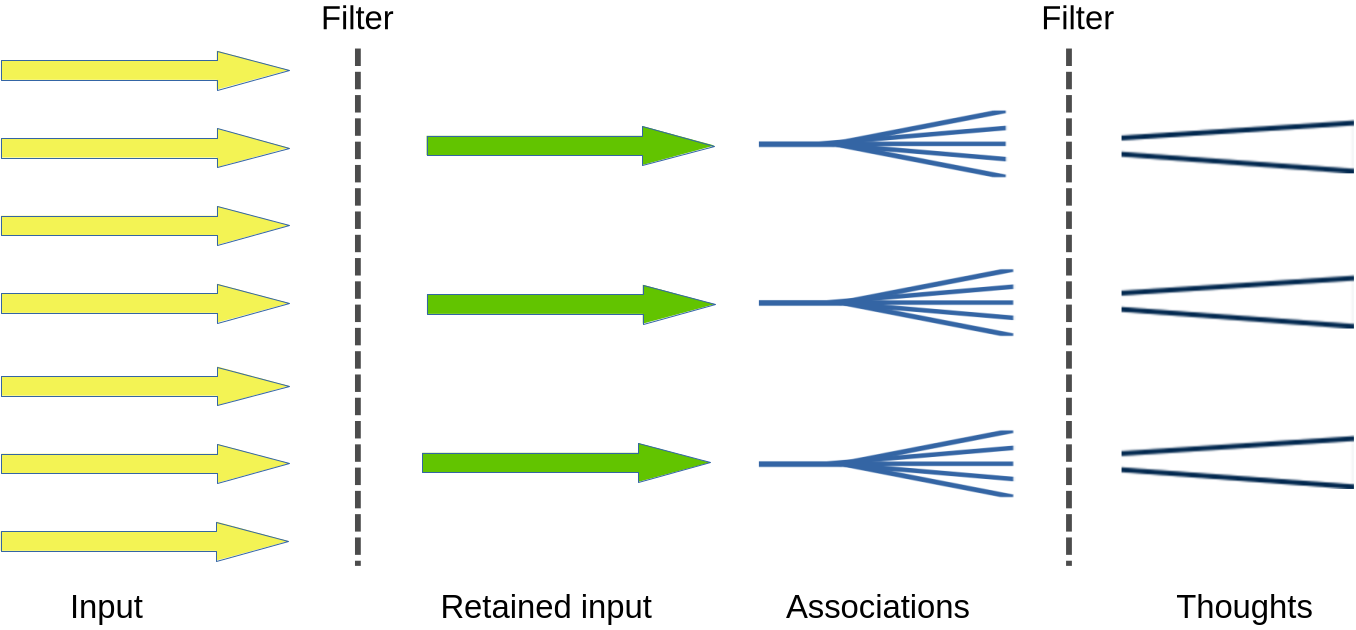
Your brain automatically is filtering and enhancing all information on several levels:
- Receiving information from outside sources (input)
- Mobilizing data in your memory (associations triggered by the input)
- Combining of the two elements, which generates your conscious thoughts and emotions
The automatic and subconscious filtering process reduces the amount of information twice. First, information from outside sources is filtered. Then, the remaining data triggers associations, which are further sorted in a second step.
The positive and negative aspects of this filtering
The first step reduces the information coming from outside. The second step reduces the number of triggered associations that you will become aware of. This process has many advantages:
- It allows you to quickly get an idea of the situation.
- It gives you a sense of control and security.
- You are able to make decisions quickly.
- Little energy is required to process the information.
This method is highly effective, but it also has some drawbacks:
- You only see a limited number of possible variations.
- Your level of creativity is limited by the choices that the sorting process allows you.
- You are less motivated to make unusual decisions.
- It takes a lot of energy to get rid of old ideas that have become obsolete.
The two filters therefore allow you to quickly get an overview during your daily activities. This mechanism reaches its limits when you find yourself in exceptional situations that require entirely new solutions. For people with ADHD, things happen differently because this filtering is altered.
The effect of neurotransmitters
In the brains of people with ADHD, dopamine and norepinephrine levels are significantly lower than in the general population. What are the effects of these two substances?
- Dopamine attenuates less important information.
- Norepinephrine reinforces relevant information.
These two neurotransmitters limit the amount of data you need to take into account. This allows you to easily get an overview of the situation and focus on what is essential. This greatly facilitates the completion of daily tasks for people without ADHD.
People with ADHD do not possess this automatic pre-filtering ability. They are therefore confronted with more information than others and must process a much larger amount of data.
Lack of filtering
The initial filtering of external information is reduced in people with ADHD. As a result, they are forced to process a greater amount of data. Subsequently, the high number of inputs retained triggers more associations. While in people without ADHD, the number of associations is reduced by another filter, this is not the case with ADHD. Not only are the associations not reduced, but the number of thoughts triggered after the second filtering explodes unchecked.
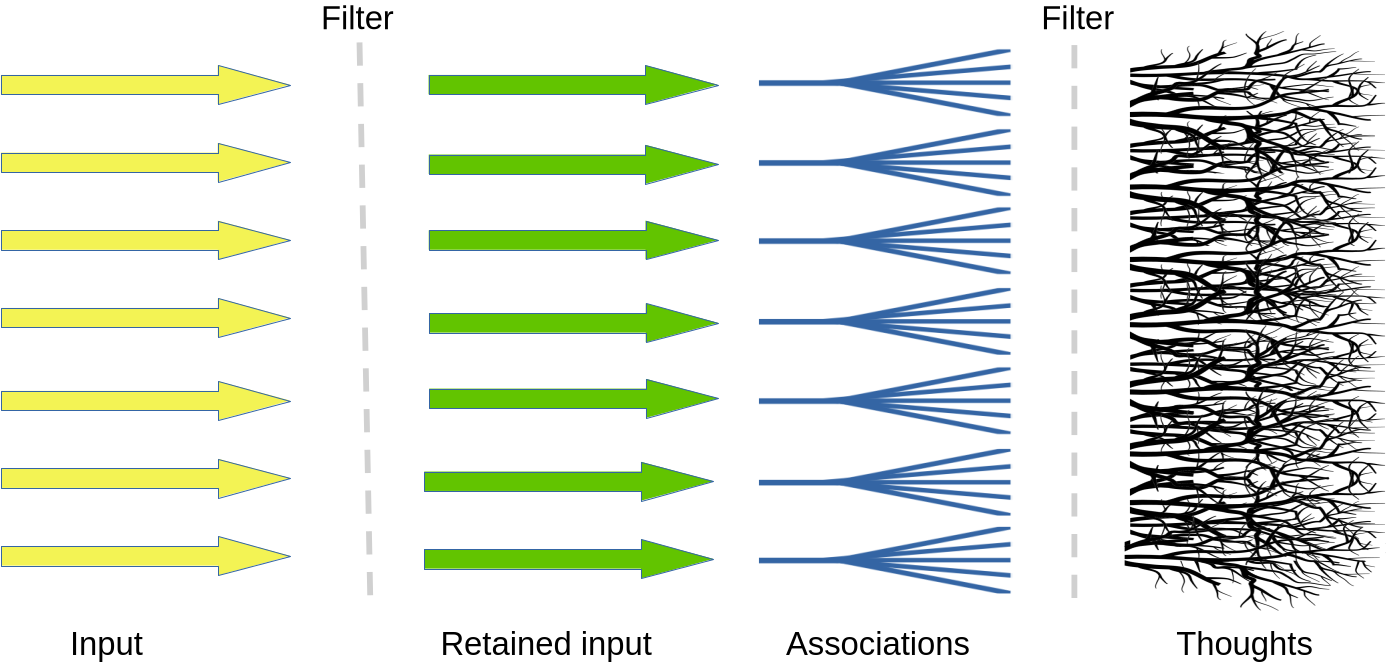
Someone with ADHD experiences infinitely more thoughts than someone without ADHD who has the same level of intelligence. As a result, they are faced with an excess of data, which leads to cognitive overload. It is not at all surprising that they easily lose sight of the big picture and have difficulty identifying what is essential.
In short, people with ADHD are forced to constantly process more information than people without ADHD.
The challenges faced by people with ADHD
The constant, overwhelming flow of unfiltered data has serious consequences on the daily lives of people with ADHD:
- Cognitive overload because it takes them a long time to orient themselves and get a general idea of the situation
- Emotional overload due to a high level of insecurity until they get an overview
- Limited ability to act because they have difficulty making decisions due to a lack of overview
- Loss of energy and exhaustion caused by the enormous effort required to process the excess of data
With such a flood of unfiltered data, it's easy to lose sight of the big picture, especially the “felt” big picture that we need to feel comfortable and secure. People with ADHD often say that they feel like they're in a fog due to the excessive amount of data. This leaves them feeling disoriented and highly insecure.
It is not surprising that people with ADHD are often exhausted (sometimes to the point of burnout) and experience a high level of stressful emotions, particularly anxiety, which often affects their mental health. They lack the automatic filters that make everyday life so much easier for most people.
The benefits of missing filtering
The disadvantages of this approach are obvious. But looking more closely, you can identify undeniable benefits:
- Creativity and innovation thanks to a wide range of perceptions and thoughts
- Potential for action in crisis situations because they have already learned to live with and manage many unclear and ambiguous situations
- Ability to make decisions in areas, even complex ones, in which they have gained extensive experience
- Enthusiasm and perseverance in subjects that fascinate them, thanks to intense emotions (ADHD hyperfocus)
The lack of pre-filtering allows for broader associations and ultimately greater creativity. It is important to realize that filtering means nothing more than censoring. What is a disadvantage in most everyday situations reveals its positive sides in exceptional circumstances, where creativity and spontaneity are essential. It is precisely these moments that people without ADHD find difficult to manage.
Exceptional responsiveness
People with ADHD are often rather slow. However, under two conditions, they are more responsive than others:
- In areas in which they have long been interested and invested: In such cases, they are quicker to perceive new conditions (thanks to the lack of filtering) and manage them rather easily. It's like a taxi driver who knows every inch of his city and immediately notices when traffic is not as usual and knows how to react immediately to avoid a blocked road.
- In areas where they have developed specific coping methods over time: These enable them to distinguish the important from the superfluous and react quickly.
Recognizing the beneficial aspects of ADHD
With his filter model, Heiner Lachenmeier primarily addresses those who constantly face difficulties at work due to their ADHD. They are well aware of their shortcomings, as they are constantly criticized for them. But it is also important for them to be aware of the advantages of their condition. This allows them to seek out a work environment that suits them and in which they can thrive.
Collaboration between people with and without ADHD
We usually criticize people with ADHD for their behavior, which is often less efficient and annoys those around them. We could tell them a thousand times that it's up to them to adapt and do better. In fact, that's what they've been doing all their lives, but with little success, because ADHD clearly imposes limitations on them.
Eckart von Hirschhausen is a comedian, talk show host, magician, and writer in Germany. He initially worked as a clinic doctor, where he reached his limits due to his ADHD. Switching to activities that called on his creativity and spontaneity allowed him to succeed. This example shows that, in the right place and the right environment, people with ADHD can excel. But when they are given tasks that are difficult to manage with ADHD, such as administration and accounting, they achieve poor results.
Instead of viewing people with ADHD as unreliable and incompetent, it is better to understand how they function and integrate them wisely into teams. That way, people with ADHD can compensate for the weaknesses of others. Ultimately, everyone benefits. This makes it truly a win-win situation.
With their altered filtering, people with ADHD are able to perceive things that most people overlook. In the right place, they can make valuable contributions to businesses and society. The same is true for other neurodivergent people, including those with autism.
Source:
- LACHENMEIER, Heiner, 2023. ADHD and success at work: how to turn supposed shortcomings into strengths. Cham: Springer. ISBN 978-3-031-13436-4.
This article was first published in French in October 2024 and has now been translated into English by the author himself.
Author of the article: Beát Edelmann, expert in neurodiversity (autism, ADHD and high IQ) and personality exploration. He is the founder of the Abundana Institute for Self-Management in Geneva, which offers coaching, training, and consulting services in French, English, and German.
