The personality macrosystems define how you approach a given situation. The metaphor of the brain palace lets you easily understand this concept.

Picture taken by Necati Ömer Karpuzoğlu (pexels.com)
Personality psychologists often ask themselves why a person acts in a certain way. What is their motive? Another approach is to ask HOW they handle a situation, in other words, which system of their personality is activated at a given moment.
The PSI theory
According to Professor Julius Kuhl at the University of Osnabrück, our personality is made up of different systems that interact with each other. His PSI (Personality Systems Interaction) theory of the personality is very comprehensive and dynamic. It takes into account that you cannot be classified into given categories, because you react flexibly depending on the circumstances. The personality systems can be assigned to seven different levels, from the most basic to the most developed in cognitive terms. Among them, the macrosystems play an important role, as they determine how each individual thinks, feels, and acts. This refers to modes of functioning, or HOW you act in a given situation.
The brain palace
These modes of functioning can be represented by the brain palace, a metaphor developed by Nicole Bruggmann, a psychologist in Zurich. The metaphor gives you a good idea of the four macrosystems without having to wade through complicated psychological works.
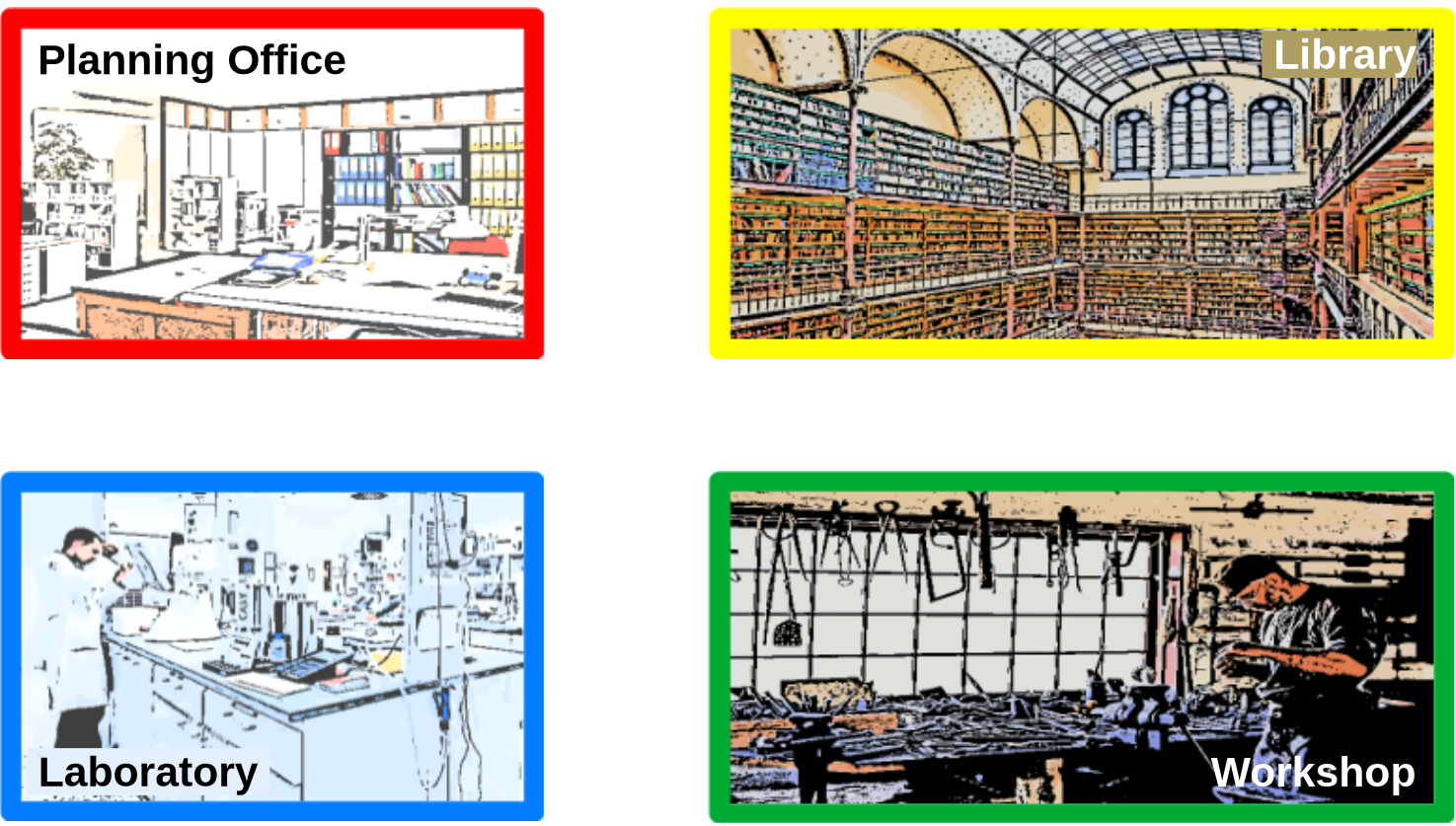
Imagine that there is a brain palace in your brain. From the outside, you can see that it has two wings and two floors. Downstairs are your laboratory and your workshop, and upstairs you have your planning office and your library. Let's start visiting each of the rooms in your palace.
The planning office
The planning office is on the upper floor. This is the place where you take care of projects that require planning before you get started. It is a modest room where you can sit at a well-lit desk. Here, you can carefully review all the documentation necessary to plan how to carry out your intentions. The space allows you to think reasonably and logically, preventing you from reacting hastily and impulsively. Thanks to your willpower and determination, you hold back your desire to act until everything is ready.
The laboratory
Below the office, you will find the laboratory. Here, your attention is focused on novelty, the unexpected, and inconsistencies. There is all the equipment you need to examine things closely, such as a microscope or a highly sensitive scale. By focusing on the details, you will be able to spot differences and errors. A “tunnel vision” allows you to see details up close, detached from the context. In this room, you can easily to recognize potential dangers and difficulties in order to avoid risks and failures. You stay here whenever you want to take a critical look at something.
The workshop
The workshop is located downstairs, next to the laboratory. This is where you go to perform tasks that your experience and habits allow you to do with ease. These are tasks that you know how to do and can perform automatically and routinely, without thinking too much about them. In your workshop, you will find all the tools you need to immediately start implementing your plans. It is therefore the place where you are in action.
The library
Above the workshop, there is a huge space filled with light and shelves lined with beautiful books. This is your personal library, containing all your experiences, every moment of your life. It is a treasure trove of knowledge that you will find in this space. By accessing this knowledge, you unleash your creativity, allowing you to find new ideas and creative solutions, as well as gain a broader perspective.
At the same time, this place is ideal for feeling your emotions and becoming aware of your needs. Furthermore, it enables you to perceive the emotions and needs of others. This is likewise the space where you can discover the meaning behind things and your values.
Moods associated with each space
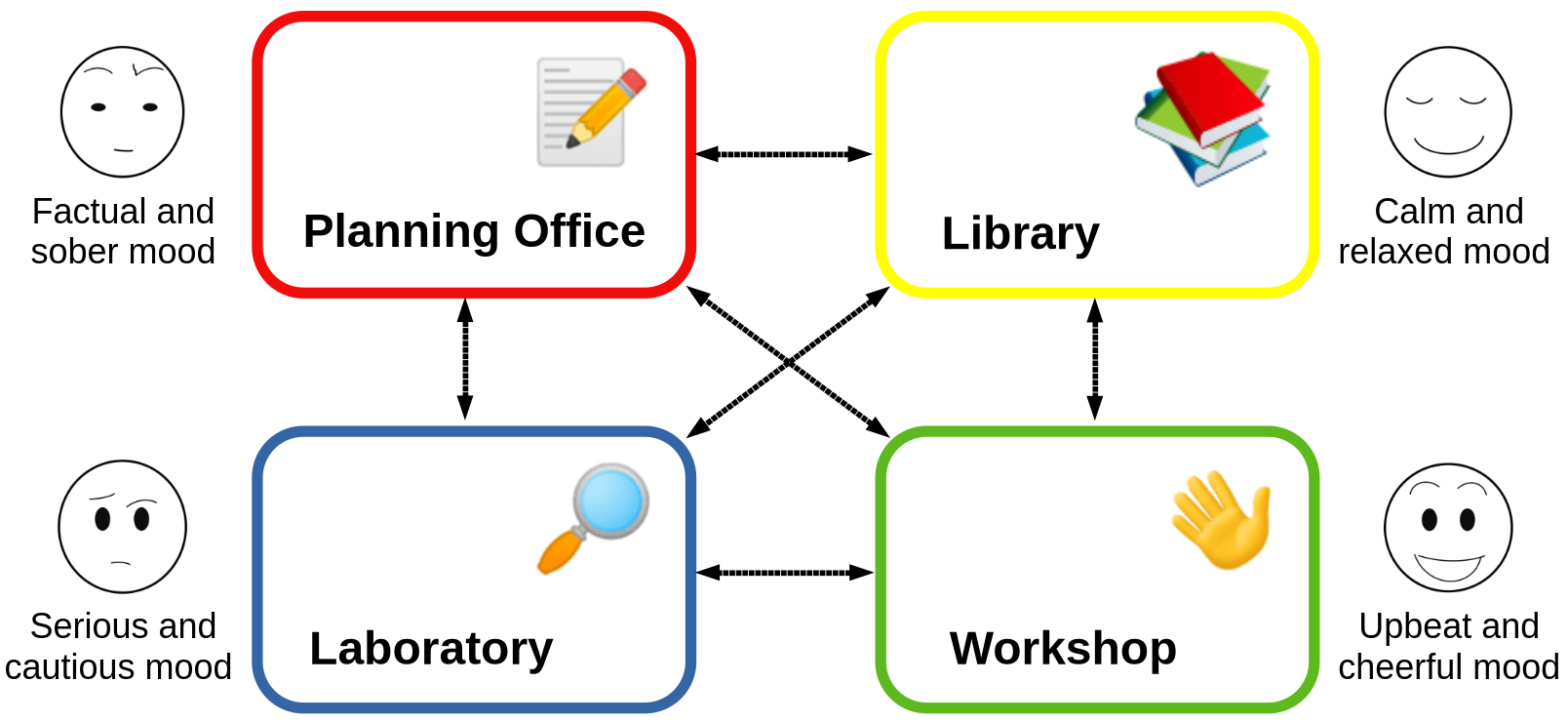
Each room has its own atmosphere that fully influences how you think and act. This is related to the activities carried out, which differ fundamentally from one room to another. Each space triggers a particular mood.
- Planning office: Planning is a serious business that requires a logical and analytical mind. In the office, you don't experience strong emotions. As a result, the atmosphere is factual and sober.
- Laboratory: In the laboratory, you search for errors and inconsistencies. This goes hand in hand with a serious and cautious mood.
- Workshop: When you know exactly what you have to do and are in control of your task, you make progress easily. Your mood is therefore upbeat and cheerful.
- Library: Surrounded by all the knowledge and experience available in your library, you can relax and let your mind wander. Your state of mind is calm and relaxed.
Therefore, each room is automatically associated with a particular mood.
The layout of the palace
The rooms in your brain palace are located in two different wings and spread over two floors. What is the meaning behind this layout?
Each wing represents one of the two systems in your brain:
- The rational mind (analytical intelligence according to Kuhl): The planning office and laboratory are governed by the rational mind. In a conscious manner, each piece of information is processed one after the other, and in a precise manner.
- The unconscious (intuitive intelligence according to Kuhl): The library and workshop are governed by the unconscious. It processes a huge amount of data at lightning speed. This gives you the big picture, and it usually works without you even noticing.
The floors correspond to two different cognitive levels:
- Basic macrosystems: Downstairs, the laboratory and the workshop are located. Their functions are at a lower level and are essential for immediate and intuitive action.
- Higher macrosystems: Upstairs, you will find the planning office and the library. These two systems belong to a higher cognitive level. They allow for the conscious and focused processing of complex information and abstract thinking. Furthermore, they operate more slowly, but in a thorough and flexible manner, taking into account the past and the future.
Colours assigned to rooms
Kuhl assigns a different color to each room. I would explain them as follows:
- Red for the planning office: This is the red light that makes you stop in order to plan how to reach your goal before taking action. Red also represents the willpower and determination you need to resist the urge to act immediately.
- Blue for the laboratory: Blue promotes concentration and supports the ability to examine objects in depth and in detail.
- Green for the workshop: The green light allows you to execute what you have planned. The color green evokes natural action, which happens automatically.
- Yellow for the library: The color yellow represents light and clarity. It is often associated with freedom of thought, creativity, and wisdom.
Moving between rooms
At any given moment, you can only be in one room. This means that only one of the four macrosystems can be active. However, you can move freely from one room to another, or even oscillate between two rooms – all in a fraction of a second.
In your daily life, you constantly make these movements without realizing it. Imagine that it is the end of the morning, and you are at home.
- You notice that you are hungry. (yellow: recognizing your needs)
- You go to the kitchen and open your refrigerator. (green: simple actions)
- You see what is available. (blue: examining the contents of the refrigerator)
- You think about what you want to eat. (yellow: discovering your desires)
- You think about the ingredients you need for a meal. (red: planning)
- You go to the supermarket and buy the items you need. (green: several simple actions)
- You take a moment to think about how you should prepare your meal. (red: planning)
- You cook. (green: several simple actions)
- You taste a dish. (blue: checking the taste)
- As a result, you think about how to improve the dish. (red: planning)
- You adjust your procedure, finish cooking, put the meal on the table, and start eating. (green: various simple actions)
- You enjoy your meal. (yellow: relaxing and paying attention to your sensations)
You're probably surprised by the number of steps involved. In reality, there are even more, because you're constantly jumping between the different spaces. A quick glance to check something, and you're in the lab – and a second later, you're deep in thought in the office.
How to get out a room
Ideally, you are in the room that best suits your current activity. Unfortunately, this is not always the case, and you may find yourself stuck in another room, for example because you are playing a video game (green) instead of doing your admin work (red).
Or you are thinking about a situation that went wrong, and you can't get rid of your negative thoughts. You are, so to speak, trapped in the blue room, the laboratory. The advice “Stop ruminating!” is absolutely useless, because that is exactly what you want to do, but you can't. What could you do here?
Changing rooms is the solution. Since each room is associated to a specific activity and emotion, you have two options to consciously move around.
- Activity: Undertaking an activity that takes you into another room. A relaxation exercise, for example, might bring you to your library (yellow), or making plan for how to avoid the bad situation in the future (red) may help.
- Emotion: Creating an atmosphere that gets you in a different mood. You could listen to calm music that relaxes you (yellow) or to a rock album in order to get you moving (green).
This knowledge gives you extraordinary leverage to leave a room that is not appropriate for your task and get to a better space. A student, for example, can use a yellow strategy to be as relaxed as possible before an exam, and thus have good access to what they have learned. Key is to be in the right macrosystem at the right time.
Terminology
Those not particularly interested in the various terms used to refer to macrosystems can skip this paragraph and move on to the next one.
The brain palace is a metaphor that facilitates the comprehension of the four macrosystems. For these, I often use the term “mode of operation,” as it clearly explains that it is about HOW you act, think, and feel at a given moment. To talk about the systems in concrete terms, I use words related to their function, such as “planning system” (see the second column of the table below). As for Julius Kuhl, as a scientific researcher, he has his own terminology, which you will find in the last column of the table.
| Brain palace | My wording | Kuhl's Terminology |
|---|---|---|
| Palace rooms | Modes of functioning | Macrosystèmes |
| Planning office | Planning system | Intention memory (red) |
| Library | Counseling System | Extension memory (yellow) |
| Laboratory | Examining System | Object recognition system (blue) |
| Workshop | Executing System | Intuitive behavior control (green) |
In his terminology, Kuhl clearly addresses an academic audience. For my clients, I prefer the metaphor of the brain palace or I talk about modes of functioning.
Learning and macrosystems
Each system has its own purpose and value, and none is better than the other. We all possess these four systems. Ideally, the macrosystem best suited to the task is activated automatically. However, it turns out that we tend to feel more comfortable in certain rooms of our brain palace than in others. In other words, we have a preferred approach, regardless of the task.
- People who prefer the planning office like to approach subjects in a structured and logical way with concrete goals in mind. They find satisfaction in making analyses, plans, and lists.
- A preference for the laboratory leads people to study with precision, thoroughness, and attention to detail. In a serious atmosphere, they seek to delve into the details and depths of subjects. The possibility of not knowing everything causes them concern.
- Those who prefer the workshop want to act with enthusiasm, try things out, and experiment. They enjoy simple and easy exercises.
- People who favor the library want to be able to identify with the subjects they are learning and see meaning in them. They like to have an overview.
Your preferences influence which way you learn best. They are mainly influenced by your past experiences. As a result, you prefer certain approaches and seek out certain moods. If you can learn a subject in your preferred space, learning will be easier for you. Knowing this, you can organize your studies in the way that suits you best.
Being in the right spot
The activated macrosystem determines how you approach a task, whether it's planning, examining, taking action, or staying relaxed. Ideally, you use the system that's most appropriate for your task. Like everyone else, sometimes you're not in the right room for a certain task.
Thanks to your knowledge of the brain palace, you are now able to identify which macrosystem you are currently using. Is it the appropriate one? If not, you can determine which room in your brain palace would be more appropriate and reach it by means of an activity or a mood that is appropriate.
The individual manner in which you move through your brain palace is part of your personality. You probably have preferences for one or more of the four spaces. Knowing your preferred macrosystems allows you to tailor your approach to your preferences. Ideally, you can even delegate activities that require a macrosystem you don't like as much. Otherwise, you now know how to navigate to the right spot in your brain palace.
Find out more about the PSI personality theory
You will find more information about the PSI personality test on the following page:
Would you like to find out more? – Get in touch with us:
Source :
- Courses on the PSI theory provided by the PSI Institut Schweiz in Zurich (only in German): www.psi-schweiz.ch
This article was first published in French in October 2024 and has now been translated into English by the author himself.
Author of the article: Beát Edelmann, expert in neurodiversity (autism, ADHD and high IQ) and personality exploration. He is the founder of the Abundana Institute for Self-Management in Geneva, which offers coaching, training, and consulting services in French, English, and German.
